Commons Game — Rules Overview
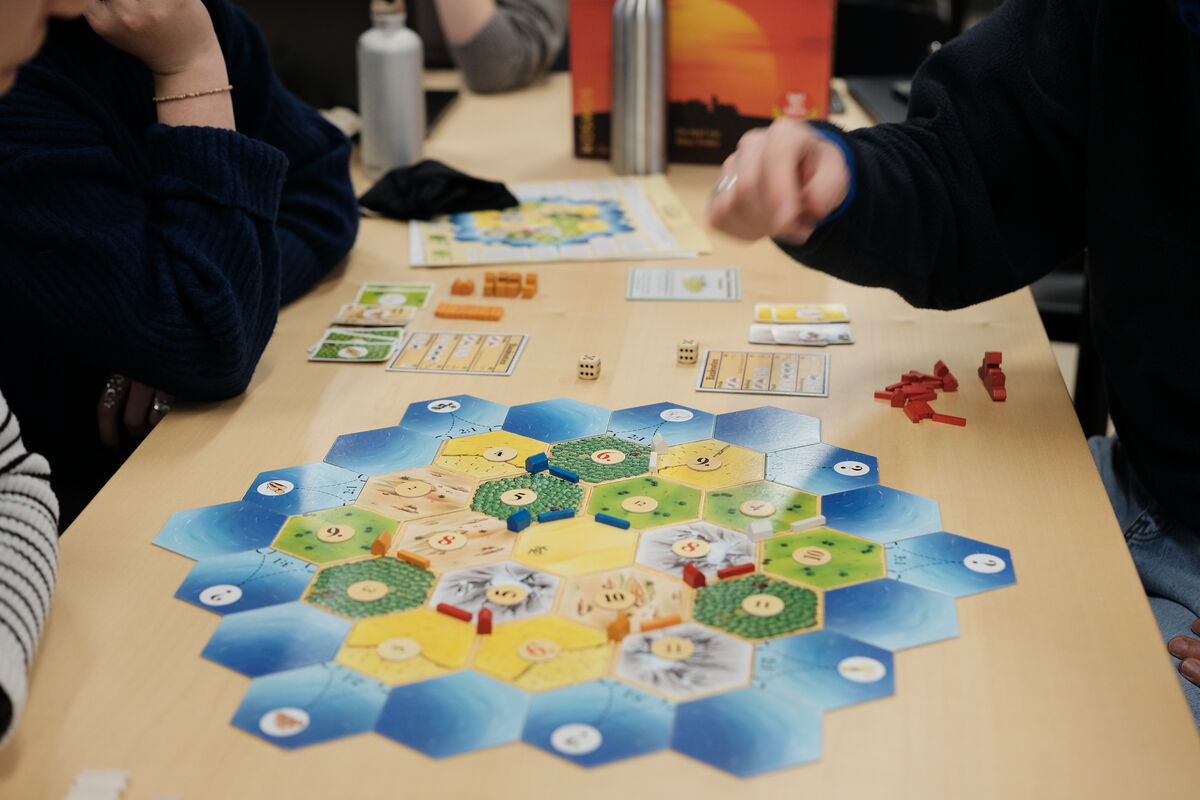
A common-pool resource (CPR) board game for exploring the collective management of commons. The game is based on a modified version of Catan.
The game is based on a version developed as part of a research study in Smith (2023).
What Is This Game?
The Commons Game lets players explore how shared resources can be sustained or depleted through the interplay of individual decisions, and how governance institutions and rules can help communities manage common-pool resources. It uses a modified version of Catan in which four players draw from a hidden, finite resource bank that grows when conserved and crashes when over-harvested.
The game is played in two stages, in order:
- Basic Variant — players use resources to reach their goals, with no communication allowed.
- Ostrom Variant — the base game is extended with additional rules that reflect Elinor Ostrom's eight design principles for managing commons.
Playing both variants back-to-back lets players explore the difference that introducing institutions and rules for self-governance makes.
1. Basic Variant
Setup
- A standard Catan board with predetermined settlement and road placements for 4 players (Red, Orange, White, Blue).
- The resource bank starts with 30 cards (6 each of lumber, brick, wheat, wool, and ore) hidden behind a barrier so players cannot see how many cards remain.
- Each player begins with 2 settlements and 2 roads already on the board.
Goal
Each player tries to survive by reaching more than 8 victory points individually within a certain number of rounds. Multiple players can therefore win — or no one can.
Victory points come from settlements, cities, and victory-point development cards.
Turn Structure
Players take turns in fixed order (Red → Orange → White → Blue). A round is complete when all players have taken a turn. Each individual player's turn consists of four steps:
| Step | Required? | What Happens |
|---|---|---|
| 1. Roll | Yes | Roll two dice. Any player with a settlement on the matching hex may request up to 3 cards of that resource (a city allows requesting up to 6 cards). Rolling a 7 produces nothing. |
| 2. Trade | No | Trade cards with the bank at 4:1 (or better if a player has a settlement on a port). No player-to-player trading. |
| 3. Build | No | Spend resource cards to build roads, settlements, or cities per the standard building-cost card, or buy a development card. |
| 4. Play a Development Card | No | Reveal a progress or victory-point card and follow its instructions. |
Resource Pool Mechanics
The hidden bank behaves like a resource-generating ecosystem:
- Growth: At the end of every round, each resource grows at a 3:1 ratio — for every 3 cards of a type in the bank, 1 more is added. A healthy bank grows faster; a depleted bank barely grows at all.
- Crash: When a resource hits 0 cards, it has crashed. It stays at 0 for 12 player turns (3 full rounds), then replenishes to 6 cards.
- Scarcity: A resource with 1–3 cards remaining is scarce — still available, but at risk of crashing.
Communication
No communication between players is allowed during the Basic Variant.
2. Ostrom Variant
All Basic Variant rules remain in effect. The following mechanics are added on top, implementing Ostrom's eight design principles for self-governance of a commons.
The Monitor
- The player with the most victory points at the start of the Ostrom Variant becomes the Monitor (ties broken by group vote).
- The Monitor tracks the resource bank and each player's resource use, and delivers graduated sanctions and rewards at their discretion.
Town Meetings
A fifth step is added to each turn: Call a Town Meeting (optional). This is the only time players may communicate. There are two types of meetings that can be called:
- Resource-Group Meeting: Called for a specific resource. Only players with settlements or cities on that resource type may discuss and vote.
- Whole-Group Meeting: All players discuss and vote.
The following rules apply for making decisions:
- Decisions pass by simple majority. Ties fail.
- Players can add, change, or remove sanction and reward rules during meetings (a minimum of 2 rewards and 2 sanctions must always be in effect).
Graduated Sanctions and Rewards
- The game begins with a preset list of sanctions and rewards that the Monitor can apply.
- Sanctions and rewards are limited to in-game consequences only (cards, points, skipped turns, etc.).
- Players may modify these rules through Town Meetings.
Sue the Monitor
- During a whole-group meeting, any player may sue the Monitor — arguing that the Monitor acted unfairly (e.g., biased sanctions, refusing to sanction themselves).
- All players vote. If the majority agrees, the Monitor must return 3 resource cards to the bank.
Ostrom's 8 Principles in the Game
| # | Principle | How It Appears |
|---|---|---|
| 1 | Clearly Defined Boundaries | Resource groups and the whole group are defined by board position. |
| 2 | Environmental Congruence | Rules can be changed to match current resource conditions. |
| 3 | Collective Choice Arrangements | Town Meetings let players create, alter, or remove rules. |
| 4 | Monitoring | The Monitor tracks the bank and player behavior. |
| 5 | Graduated Sanctions/Rewards | The Monitor delivers in-game consequences for cooperation or defection. |
| 6 | Conflict Resolution | Players can Sue the Monitor to address grievances. |
| 7 | Right to Organize | The instructor (external authority) cannot override player-made rules. |
| 8 | Nested Enterprises | Governance operates at both resource-group and whole-group levels. |
3. Player Roles
Players can take on different roles.
| Role | Variant | Description |
|---|---|---|
| Player | Both variants | Takes turns, requests resources, builds, and tries to reach 8+ victory points. Referred to by color (Red, Orange, White, Blue). |
| Monitor | Ostrom only | Determined by victory points at the time of switching to the Ostrom Variant. Tracks the resource bank and player behavior, and delivers sanctions/rewards. Accountable to the group and can be sanctioned via Sue the Monitor. |
| Observer | Both variants (optional) | Watches the game without participating. Tracks key events (crashes, sanctions, cooperation) and prepares notes for post-game discussion. |
| Instructor | Both variants | Sets up the board, manages the hidden bank, enforces core rules, and announces variant transitions. Does not interfere with player-made rules during the Ostrom Variant. |
Quick Reference — Variant Differences
| Basic Variant | Ostrom Variant | |
|---|---|---|
| Players | 4 | 4 (one becomes Monitor) |
| Communication | None | During Town Meetings only |
| Steps per turn | Roll, Trade, Build, Dev Card | Roll, Trade, Build, Dev Card, Town Meeting |